
Parts reference
Weatherseal profiles and retainers — identifying the right one
Garage door bottom seals are not interchangeable: the seal's end profile must match the retainer channel on the door — T-end, bead and U-shape systems all exist and none fits another's channel. Identifying which you have takes one photograph of the old seal's cross-section, and it is the difference between a five-minute job and a second trip to the store.
Before ordering: measure and photograph
- 1.A cross-section photograph of the old seal's end profile, cut square if needed
- 2.The retainer: bare wood or steel door edge with nails/screws, or an aluminium channel — and if a channel, single or double groove
- 3.Door width, plus a few inches of trim allowance
- 4.The gap being sealed: even along the floor, or wider at one end (a settled slab wants a taller or dual-fin profile)
- 5.For jamb and header seals: the profile of the existing stop-moulding seal, photographed end-on
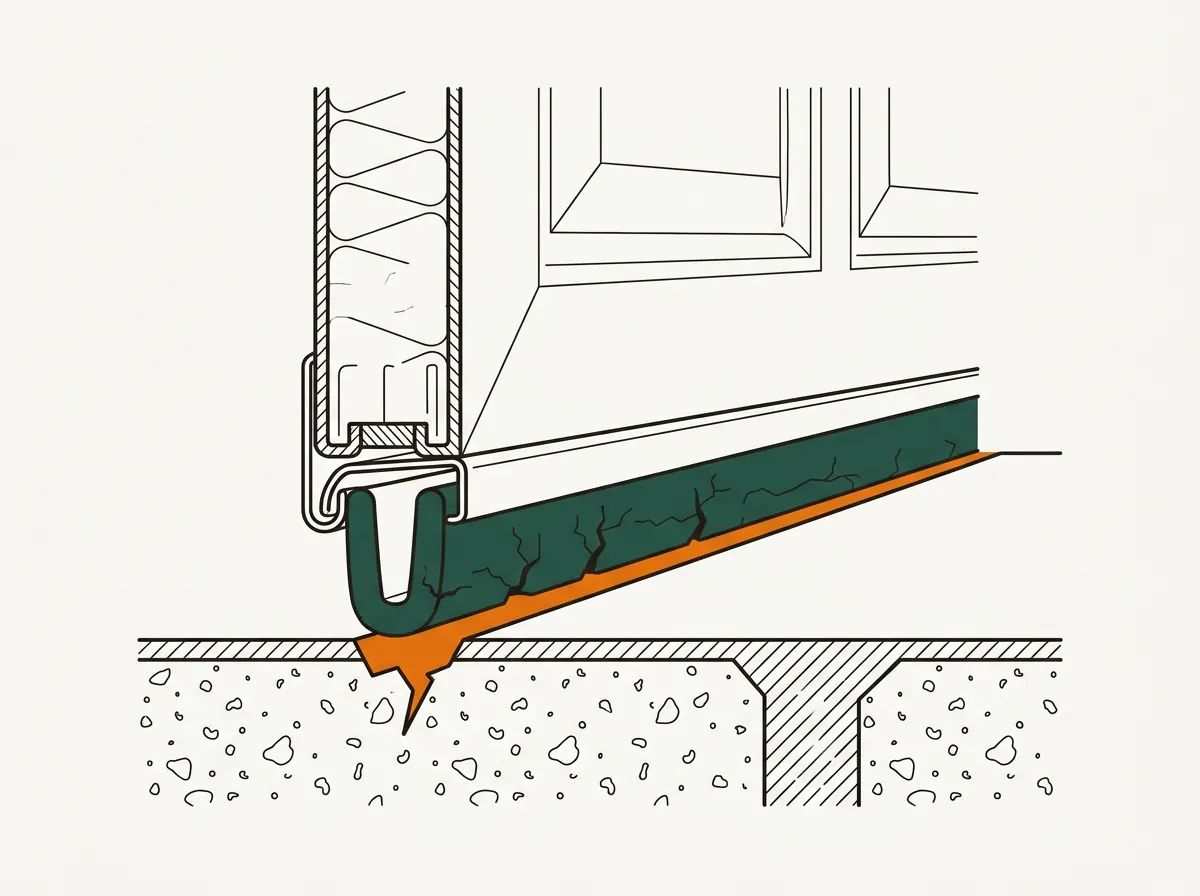
Seal and retainer as a system. The end profile sliding through that channel is the match that has to be right — photograph the cross-section, not the length.
Where identification ends
Seal work is the safest job on the door — nothing here is under tension. The one rule is to work with the door closed or fully open and the opener disconnected, so nothing moves while hands are under the bottom edge.
Reading the bottom-seal system
Look at the bottom edge of the door. A steel or wood edge with the rubber nailed or screwed directly to it takes a flap-style seal, fixed the same way. An aluminium channel means the seal slides in from the end, and the channel's groove shape dictates the seal's end profile.
T-end seals have ends shaped like a T that slide into matching slots; bead-end seals end in a round bulb; U-shape seals wrap into a wider single channel. The names vary by supplier, which is why the photograph of the cross-section beats any description — a supplier shown the profile identifies the system at a glance.
Single-channel and double-channel retainers both exist, and a U-shape seal for a double channel will not seat in a single. If the retainer itself is bent, corroded or pulling off the door, replace it with the seal — a good seal in a bad channel does not sit flat, and the retainer costs little.
Profile height, and the settled-slab problem
Seals come in profiles of different heights, and taller is not automatically better — an oversized seal drags, folds under the door and wears out early. The right height fills the gap with gentle compression at the tightest point.
Slabs settle unevenly, and the classic symptom is daylight at one end of a closed door. The fix is a taller or dual-fin profile that conforms across the varying gap, not shimming the track or over-closing the opener — forcing the door down against a high spot is how openers lose their travel settings and bottom sections get stressed.
In freeze-thaw climates, the seal is also what stops meltwater pooling and refreezing under the door. A hardened seal that has taken a set stops shedding water, the door freezes to the slab, and the next opener cycle bends something. The seal is the cheap part of that chain.
The rest of the perimeter
Jamb and header seals mount to the stop moulding around the sides and top of the opening, with a flexible lip that lays against the door face. They are sold by profile and length, identified the same way — an end-on photograph — and they do most of the work of stopping wind-driven rain and daylight at the edges.
Between-section seals and top-of-door brush seals exist for specific problems — dust-heavy sites, pest exclusion — and are additions rather than replacements.
Thresholds are the floor-mounted half of the system: a raised rubber strip glued to the slab under the door line, sealing against the bottom seal from below. They excel at keeping driven rain and drifting leaves out of a sloped driveway garage, at the cost of a lip you will sweep against forever. Photograph, measure the width, and buy the kit with adhesive included.
Common questions
How do I know which bottom seal my garage door takes?
Photograph the old seal's end profile in cross-section and look at the retainer. Rubber fixed directly to the door edge takes a flap seal; an aluminium channel takes a slide-in seal whose end — T, bead or U-shape — must match the channel's grooves. The photograph identifies it faster than any description.
Why does my new garage door seal leave a gap at one end?
The slab has settled unevenly, so a straight seal at the correct height for one end is too short for the other. The fix is a taller or dual-fin profile that conforms across the varying gap — not closing the opener harder, which stresses the door and its travel settings.
Are garage door seals universal?
No. The end profile must match the retainer channel — T-end, bead and U-shape systems are mutually incompatible — and profiles come in different heights for different gaps. Matching the cross-section photograph is what makes it a one-trip job.
Get a tech dispatched
Tell us what the door is doing and where you are. We'll connect you with a licensed contractor in your area — usually within the hour.
We pass your details to one licensed contractor serving your ZIP. We don't sell your information to multiple companies. Privacy