
Parts reference
Extension springs — identification, ratings and safety cables
Extension springs are the other counterbalance system: a spring on each side stretching along the horizontal track, rated by pull weight rather than by torque. The single most important thing on any extension-spring door is not the spring — it is the safety cable that must run through the middle of each one, because a stretched spring that snaps without one becomes a projectile.
Before ordering: measure and photograph
- 1.The paint colour on the end coil or loop — it encodes the pull-weight rating
- 2.Stretched length with the door closed, and relaxed length with the door open, photographed
- 3.End style: open loop, double loop, or clipped ends
- 4.Whether a safety cable runs through the centre of each spring — if not, that is the first purchase, not the spring
- 5.Door weight, measured with a bathroom scale under the closed door with the springs disconnected by a professional if in any doubt
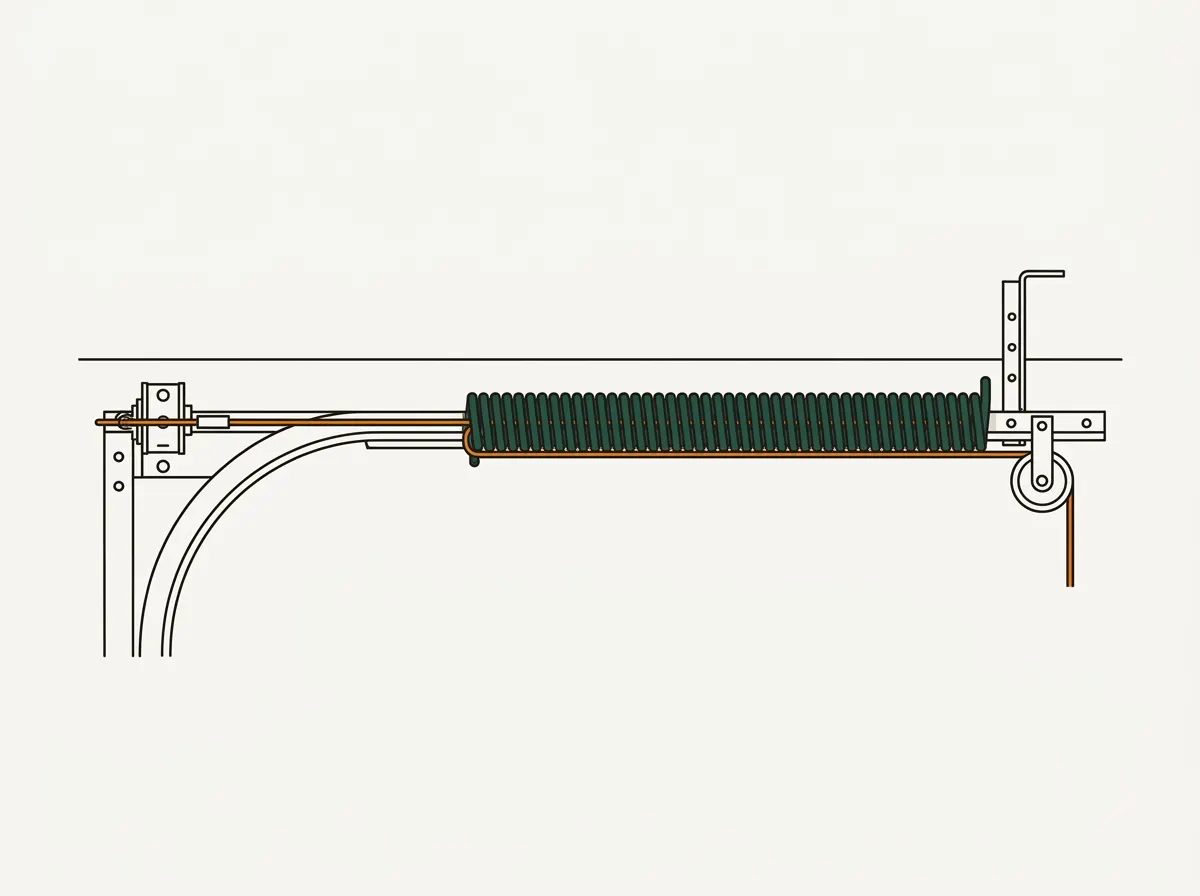
The safety cable runs through the middle of the coils and anchors at both ends. It does nothing until the spring snaps — and on that day it is the only thing containing it.
Where identification ends
A stretched extension spring stores its energy along its whole length, and unlike a torsion spring it is not contained on a shaft. If it or its pulley fails without a safety cable installed, the spring whips through the garage at head height. Identification from the ground is safe; disconnecting, stretching or re-hanging springs is professional work.
How extension springs differ from torsion
A torsion system stores energy by twisting a spring on a shaft above the opening. An extension system stores it by stretching a spring alongside each horizontal track, connected through pulleys and cables to the door's bottom brackets.
Extension setups are common on older doors and on garages with too little headroom above the opening for a torsion shaft. They are cheaper, harder to balance precisely — each side works independently, which is why extension-spring doors so often sit crooked — and they fail more dramatically.
The two systems are not interchangeable part-for-part, but a torsion conversion is a standard job on most doors with the headroom for it, and worth pricing whenever both extension springs need replacing anyway.
The colour code on the end coil
Extension springs carry a paint mark on the end coil or loop that encodes the pull-weight rating under an industry colour code maintained by DASMA, the door manufacturers' association. Suppliers read the colour and match the rating directly.
Photograph the paint before it matters — the mark corrodes and flakes, and on a spring old enough to be failing it is often half gone. If the colour is unreadable, the fallback is the honest one: weigh the door and buy springs rated for it, one per side, each rated for the full door weight in a standard two-spring setup.
We do not reprint the colour-to-weight table here because published versions disagree at several points and we cannot verify one against the standard itself. The colour is for your supplier to read; the weight of your actual door is the specification.
Safety cables are the whole story
A safety cable is a length of steel cable threaded through the centre of the extension spring and anchored at both ends — to the track hanger at the back and near the track bracket at the front. It does nothing at all until the day the spring or a pulley lets go, and on that day it is the only thing containing a steel coil released at full stretch.
They cost a few dollars each and fit in minutes. Any extension-spring door without them should have them installed before anything else is spent on that door, and any technician replacing extension springs without fitting them is cutting the one corner that matters.
Check yours from the ground right now: look along each horizontal track for a thin cable running through the middle of the spring's coils. Through the middle — a cable clipped alongside the spring contains nothing.
Common questions
What do the colors on garage door extension springs mean?
The paint on the end coil encodes the spring's pull-weight rating under an industry colour code. Photograph it for your supplier — and if it has corroded off, the reliable fallback is to weigh the door and order springs rated for that weight, one per side.
Do extension springs need safety cables?
Yes, without exception. The cable runs through the centre of each spring and anchors at both ends, so a snapped spring is contained instead of whipping through the garage. If your extension-spring door lacks them, fit them before spending anything else on the door.
Should I convert extension springs to a torsion system?
If both springs need replacing anyway and the garage has headroom for a shaft, it is worth pricing. Torsion systems balance the door evenly instead of side-by-side, fail contained on a shaft rather than at stretch, and drift out of balance less. On a door with one healthy spring, conversion rarely pays.
Get a tech dispatched
Tell us what the door is doing and where you are. We'll connect you with a licensed contractor in your area — usually within the hour.
We pass your details to one licensed contractor serving your ZIP. We don't sell your information to multiple companies. Privacy