
Parts reference
Torsion springs — how to identify and measure one
A torsion spring is fully specified by four measurements: wire diameter, inside diameter, overall length, and wind direction. All four can be read off a broken spring with a tape measure while it sits on the shaft, and together they are everything a supplier needs to provide the correct replacement.
Before ordering: measure and photograph
- 1.Wire size — measure the length of 10 coils and again across 20 coils, in inches, and photograph the tape in place
- 2.Inside diameter — often stamped on the winding cone (P-175 means 1¾ in), otherwise measure across the opening
- 3.Overall length of the spring body, wound, excluding the cones
- 4.Wind direction — which way the wire spirals, viewed from the end
- 5.Whether the door has one spring or two, and where the broken one sits relative to the centre bracket
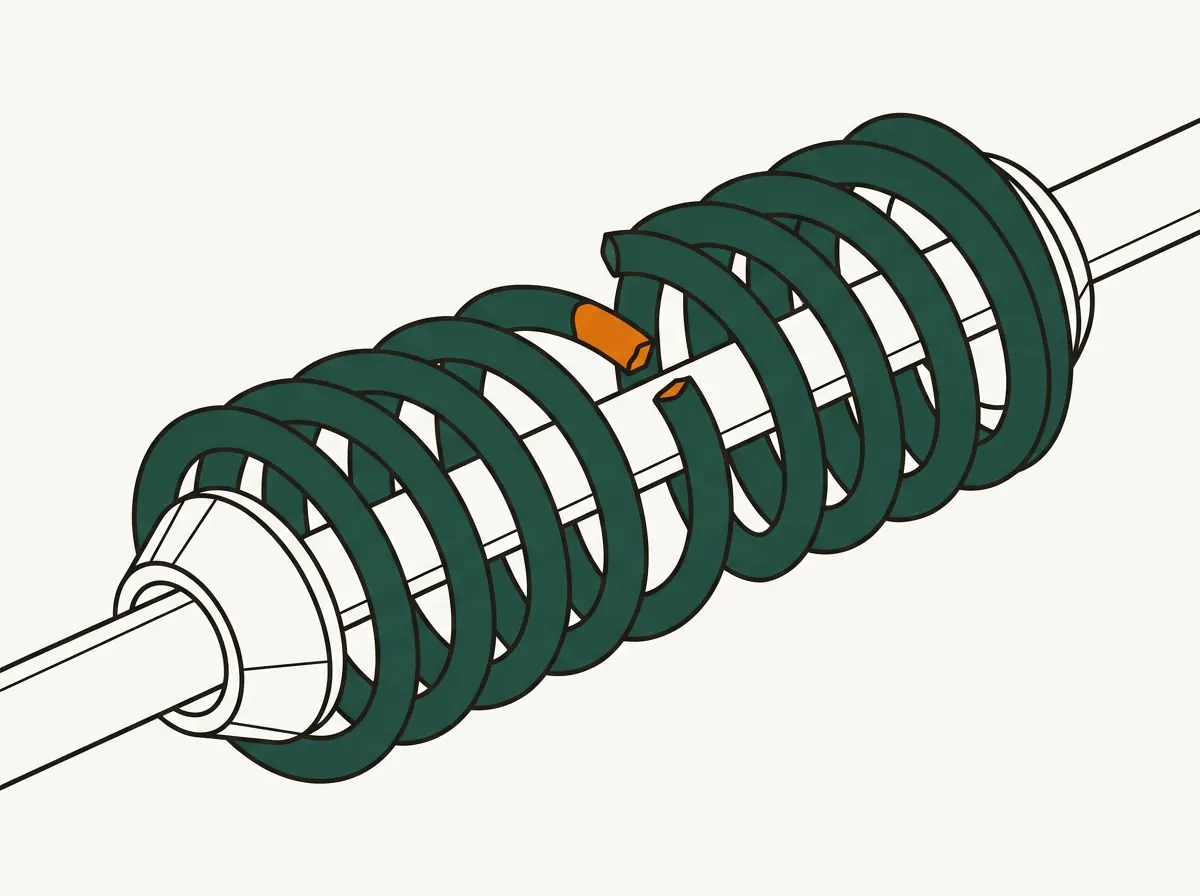
The three measurable features in one frame: the coils (wire size), the cone (inside diameter and wind), and the break — measure both pieces pushed closed and add them for length.
Where identification ends
Everything on this page is measurement of a spring at rest, which is safe. Winding or unwinding a spring is not — an intact spring on a closed door is storing in the region of 2,000 inch-pounds, and it is released only through winding bars by someone trained to do it.
Wire size: the 10-and-20-coil method
Wire diameter is the measurement that matters most and the one a caliper is not needed for. Lay a tape along the spring and measure the length of exactly 10 coils, then of exactly 20, in inches.
Ten coils measuring 2½ inches is 0.250-inch wire. Twenty coils measuring 4⅝ inches is 0.2312-inch wire. The 20-coil reading exists to catch the sizes that differ by a few thousandths — several standard wire sizes are close enough that a 10-coil reading alone is ambiguous.
Measure on a section of intact, closed coils away from the break and away from the cones, and push the coils together before reading. A gap anywhere in the run under the tape inflates the number and orders the wrong spring.
Inside diameter and length
The inside diameter is usually printed or cast on the winding cone: P-175 and D-175 both indicate 1¾ inches, 2 means 2 inches. Residential doors are overwhelmingly 1¾ or 2 inches. If the cone marking has worn off, measure straight across the opening of the spring, inside edge to inside edge.
Length is the wound spring body only, cone to cone but excluding both cones. On a broken spring, measure both pieces pushed closed and add them — the break does not remove material.
A two-spring door does not always carry two identical springs. Measure both, because mixed setups — different lengths balancing an off-centre weight like a row of windows — are common and correct.
Wind direction, and the paint convention
Look at the spring end-on. Wire spiralling away clockwise is a right-wound spring; counter-clockwise is left-wound. On a standard residential setup viewed from inside the garage, the right-wound spring mounts on the left side of the centre bracket and the left-wound spring on the right.
There is a widespread paint convention — red winding cone for right wind, black for left — and it is usually reliable. It is a convention, not a standard, and repainted or replacement cones lie. Trust the spiral, not the paint.
Ordering the correct wind matters because a spring wound the wrong way cannot be tensioned onto the door at all. It is the one specification error that announces itself immediately rather than through early failure.
Cycle rating is a choice, not a measurement
Nothing on the old spring tells you its cycle rating. Rating is set by the relationship between wire size, diameter and length — a higher-cycle spring for the same door is typically longer with heavier wire, delivering the same torque at lower internal stress.
That makes replacement time the one moment the rating can be chosen. Matching the old spring reproduces the old lifespan; specifying 25,000 cycles adds $80 to $150 and roughly two and a half times the life. Which is worth it depends on daily cycles — the arithmetic is on our spring cycle ratings page.
Common questions
How do I measure a garage door torsion spring?
Four measurements: wire size (measure the length of 10 and of 20 coils in inches — 10 coils at 2½ in is 0.250 wire), inside diameter (stamped on the cone, e.g. P-175 for 1¾ in), overall length of the wound body excluding cones, and wind direction (the way the wire spirals, viewed end-on). All four can be taken safely on a spring at rest.
What does the red or black winding cone mean?
By common convention red marks a right-wound spring and black a left-wound one. It is a convention rather than a standard, so verify against the spiral itself: viewed end-on, wire running clockwise away from you is right wind.
Can I measure the spring myself safely?
Yes. Measuring a spring at rest with a tape — coils, diameter, length, wind — involves no stored energy. What is never safe without training and winding bars is turning the cones: winding, unwinding, or loosening the set screws on a tensioned spring.
Get a tech dispatched
Tell us what the door is doing and where you are. We'll connect you with a licensed contractor in your area — usually within the hour.
We pass your details to one licensed contractor serving your ZIP. We don't sell your information to multiple companies. Privacy