
Parts reference
Opener parts — identifying gears, capacitors, boards and rails
Every opener part order starts with the same two photographs: the model label on the motor housing, and the colour of the learn button under the light cover. Together they identify the unit and its radio generation — and they prevent the standard failure of opener repair, which is buying the right part for the wrong machine.
Before ordering: measure and photograph
- 1.The model and serial label on the motor housing, photographed square-on
- 2.The learn button colour under the light lens — it identifies the radio generation for remotes
- 3.For a suspected gear failure: whether the motor runs with nothing moving, and any nylon shavings visible inside the housing
- 4.For a suspected capacitor: the µF rating and voltage printed on the old can
- 5.Drive type — chain, belt, screw or direct — since gear kits and trolleys are drive-specific
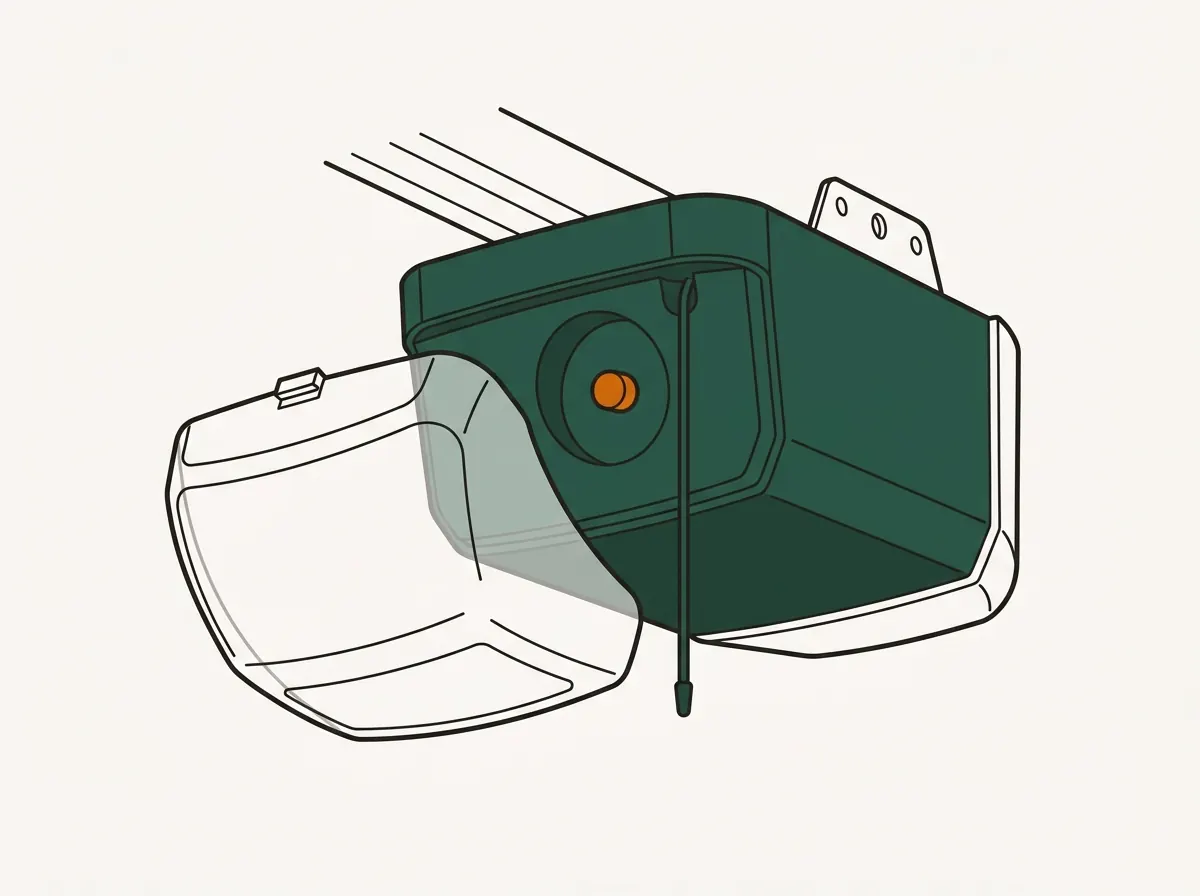
The second of the two photographs: the learn button under the light cover. Its colour identifies the radio generation, which governs every remote and keypad decision.
Where identification ends
Unplug the opener before opening the housing, and treat the capacitor with respect — a start capacitor can hold charge after power is removed and is discharged before handling. None of this involves spring tension, which is what makes opener parts the most homeowner-serviceable category on this site.
The two photographs that prevent wrong orders
The model label carries the model and serial number, and on most brands the serial encodes the manufacture date. Parts diagrams, gear kits and boards are all indexed by that model number — from the label, not from memory, because families of near-identical openers differ internally.
The learn button colour identifies the radio system generation, which is what actually governs remote and keypad compatibility. The same nominal model shipped across more than one radio generation, which is why the button outranks the model number for anything wireless.
With both photographs, a parts counter or a search can produce the exact gear kit, board or remote. Without them, the process is guesswork with return postage.
The three parts that actually fail
The drive gear. On chain and belt units the nylon main gear is the designed weak point, and it announces itself unmistakably: the motor runs at full speed and nothing moves, often with white shavings dusting the inside of the housing. A gear kit — main gear, worm gear, grease, retainers — is indexed to the model number and is the classic repair.
The start capacitor. A motor that hums for a second and gives up, or needs a spin to start, is usually the capacitor. The replacement rating is printed on the old can in µF and volts; match both. It is one of the cheapest real repairs on the whole door.
The logic board. Surge and lightning kill boards, and the symptoms are erratic rather than absolute — intermittent response, lights flashing in patterns, phantom reversals. Boards are model-indexed and often shared across brand families, which is where the cross-brand relationships on our brand pages save real money.
Rails, trolleys and the parts that ride them
The trolley — the carriage the door arm attaches to, with the red emergency release hanging from it — is drive-specific: a chain trolley, a belt trolley and a screw-drive carriage are different parts entirely. Identify the drive before ordering.
Chains stretch and belts wear where they wrap the sprocket; both are adjustable at the trolley up to a point, and replaceable as model-indexed assemblies past it. A screw-drive carriage that grinds is usually a dry rail first and a worn carriage second — lubricant rated for screw drives before parts.
Photo-eye sensors are the one opener part best bought as a matched pair for the same brand generation as the unit — mixed-generation sensor pairs are a steady source of doors that close only sometimes, which reads as a haunted opener and is actually a parts mismatch.
Common questions
What should I photograph before ordering opener parts?
Two things: the model and serial label on the motor housing, and the learn button colour under the light cover. The label indexes every mechanical part — gear kits, boards, trolleys — and the button colour identifies the radio generation, which governs remotes and keypads.
How do I know if my opener's drive gear is stripped?
The motor runs at normal speed and the door does not move, frequently with fine white nylon shavings visible inside the housing. The gear is the designed sacrificial part; the repair is a model-indexed gear kit rather than a new opener.
Are opener parts interchangeable between brands?
Within corporate families, often: LiftMaster, Chamberlain and most Craftsman units share a manufacturer, as do Genie and Overhead Door. Across families, effectively never — and radios cross only within the same generation even inside a family, which is what the learn button colour tells you.
Get a tech dispatched
Tell us what the door is doing and where you are. We'll connect you with a licensed contractor in your area — usually within the hour.
We pass your details to one licensed contractor serving your ZIP. We don't sell your information to multiple companies. Privacy