
Parts reference
Lift cables, drums and bottom brackets — the tension path
The lift cable, the cable drum and the bottom bracket are one load path: the spring twists the shaft, the drum winds the cable, and the cable lifts the door from the bottom bracket. Identifying any of them for replacement is safe to do by eye; unbolting a bottom bracket on a tensioned door is the most dangerous mistake a homeowner can make on a garage door.
Before ordering: measure and photograph
- 1.Cable diameter — 1/8 in is typical residential; 3/32 in on lighter doors — and construction if visible on a tag
- 2.Cable length, measured on the intact side from drum to bottom bracket with the door closed
- 3.Drum marking — residential standard-lift drums are commonly cast with '400-8' — photographed from below
- 4.End fittings: looped ends over a bottom-bracket post, or a crimped stop in a slotted drum
- 5.Where fraying sits: bottom of the cable (moisture), at the drum (misalignment), or mid-run (contact with something)
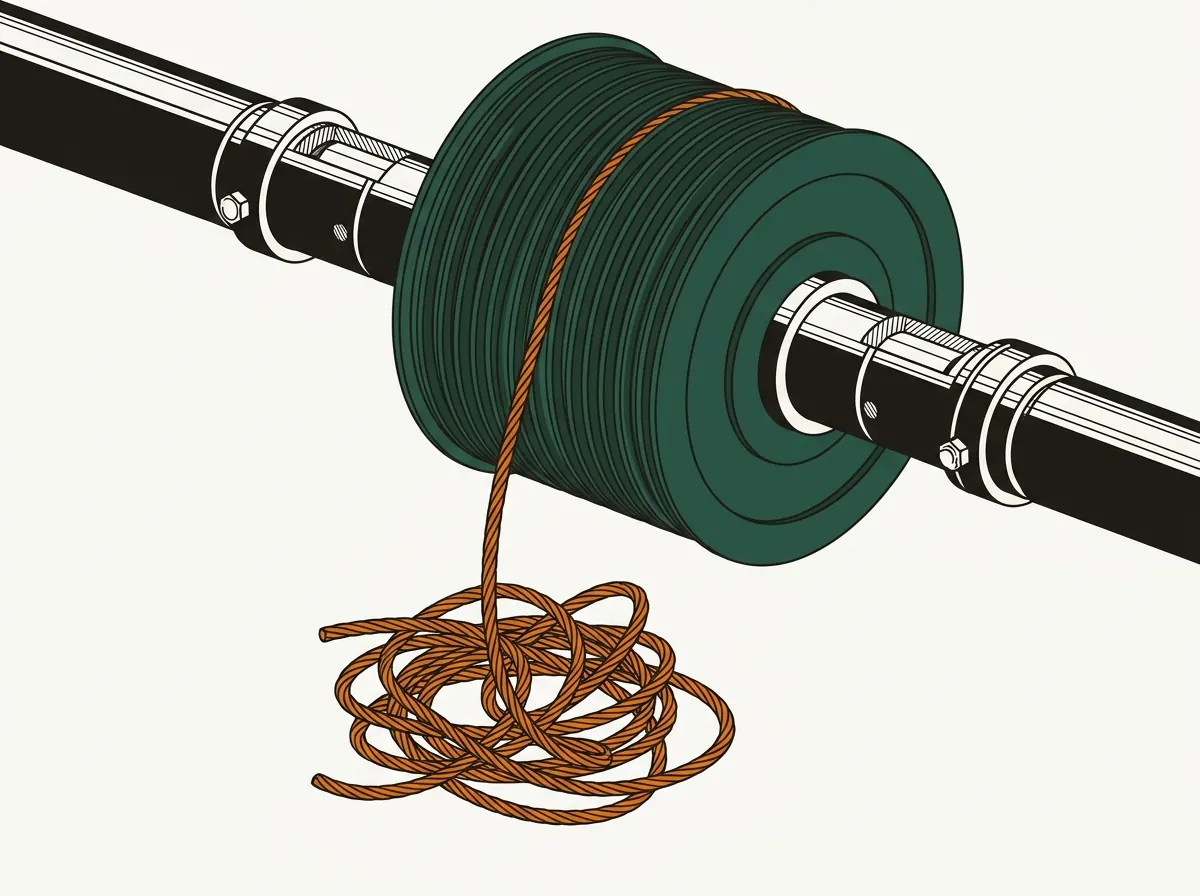
The drum's grooves are the identification: flat and even along a cylinder is standard lift. A cable off its drum like this usually means the tension, not the cable, is the story.
Where identification ends
The bottom bracket is the anchor the entire spring force pulls against. Its bolts are the one fastener set on the door that must never be loosened while the system is under tension, and on many doors they are tamper-resistant fasteners for exactly that reason. Everything else on this page is looking and measuring.
Reading a drum
The drum at each end of the shaft converts the spring's torque into cable pull. Residential drums for a standard 7-to-8-foot door are usually cast with a moulding mark such as 400-8, and matching that casting is the simplest way to order a like-for-like replacement.
The groove profile is the tell for the door type. Flat, even grooves along a cylindrical drum are standard lift. A drum that steps up to a cone means high-lift or full-vertical-lift hardware — common in garages with car lifts — and that entire cable-and-drum system is specified differently.
Drums fail by wearing the groove edges, by cracking at the set-screw boss, and by being bent in the same impact that threw the cable. A cable that repeatedly jumps a drum that looks straight is usually telling you the drum is not straight.
Reading a cable
Residential lift cables are galvanised aircraft-type cable, most commonly 1/8-inch on standard doors and 3/32-inch on lighter single doors. The honest identification is diameter plus length plus end style, measured on the intact side.
Length is drum-to-bracket with the door closed, plus the wraps that remain on the drum. Buying pre-cut cables for the door height stated on the door's label avoids the arithmetic; a supplier quoted the door height and drum casting can supply the pair.
Fraying location is diagnostic. At the bottom near the bracket, it is moisture and age, and the fix is cables. At the drum, the drum alignment or a worn groove is the cause and new cables alone will fray the same way. Cables are replaced in pairs — the second one has the same mileage.
The bottom bracket, and why its bolts are different
The bottom bracket carries three jobs: it anchors the cable, it holds the bottom roller, and on many doors it is where the whole counterbalance force terminates. While the springs are wound, its fixing bolts are structural in the same sense as the winding cones.
Manufacturers increasingly fit them with tamper-resistant heads — a deliberate obstacle, and one worth respecting rather than defeating. The correct sequence for any bottom-bracket work is: tension off, then bracket.
For identification purposes: photograph the bracket from the side showing the cable attachment post and the roller carrier. Left and right brackets are mirrored, not interchangeable, and replacements are ordered as a handed pair.
Common questions
What size cable does a garage door use?
Most residential doors use 1/8-inch galvanised lift cable; lighter single doors sometimes use 3/32-inch. Match diameter, length (measured on the intact side, door closed) and end style, and replace both cables together — they carry the same mileage.
What does the 400-8 marking on my cable drum mean?
It is the casting designation of the most common residential standard-lift drum size. Photograph the marking and match it for a like-for-like replacement; a drum that steps into a cone shape instead indicates high-lift or vertical-lift hardware, which is specified as a system.
Why can't I just unbolt the bottom bracket to replace a cable?
Because the bracket is what the wound springs are pulling against. Loosening its bolts under tension releases the full counterbalance force through the bracket without control. Spring tension is released first, every time — which is why this is a professional repair despite the cable itself costing a few dollars.
Get a tech dispatched
Tell us what the door is doing and where you are. We'll connect you with a licensed contractor in your area — usually within the hour.
We pass your details to one licensed contractor serving your ZIP. We don't sell your information to multiple companies. Privacy